
Yes, aluminum foil is recyclable and can be recycled multiple times without losing its original quality, strength or barrier properties.
But contamination and lack of awareness keep most of the aluminum foil out of the recycling stream.
Aluminum is one of the most valuable materials in modern packaging because of its inherent properties, like inertness, excellent barrier and flexibility.
This is why it is found in everything from kitchen foil to pharmaceutical blister packs.
Unlike plastic and paper materials that degrade upon recycling, aluminum foil can be melted again and used repeatedly.
The Growing Use of Aluminum Foil
The aluminum foil passes through several energy-intensive industrial processes before being used for pharmaceutical packaging, food packaging, electronics, automotive components and countless household applications.
Today, aluminum foil is everywhere.
As consumption increases, waste will go up.
Unfortunately, millions of tonnes of recyclable aluminum foil never reach to the recycling facilities.
As a result, we aren’t only losing material, but energy as well.
Because throwing away aluminum foil breaks the circular economy and completely wastes the energy used to create it.
Since aluminum can be recycled infinitely without losing quality, discarding it forces us to mine new raw materials.
This unnecessary process burns 95% more energy than simply melting down and reusing the old foil.
So, the question shall not be “Is aluminum foil recyclable?” but rather “Why are we still throwing such a valuable resource away?“
How Aluminum Foil Is Made
To understand why recycling of Aluminum foil matters, it is important to understand how it is made.
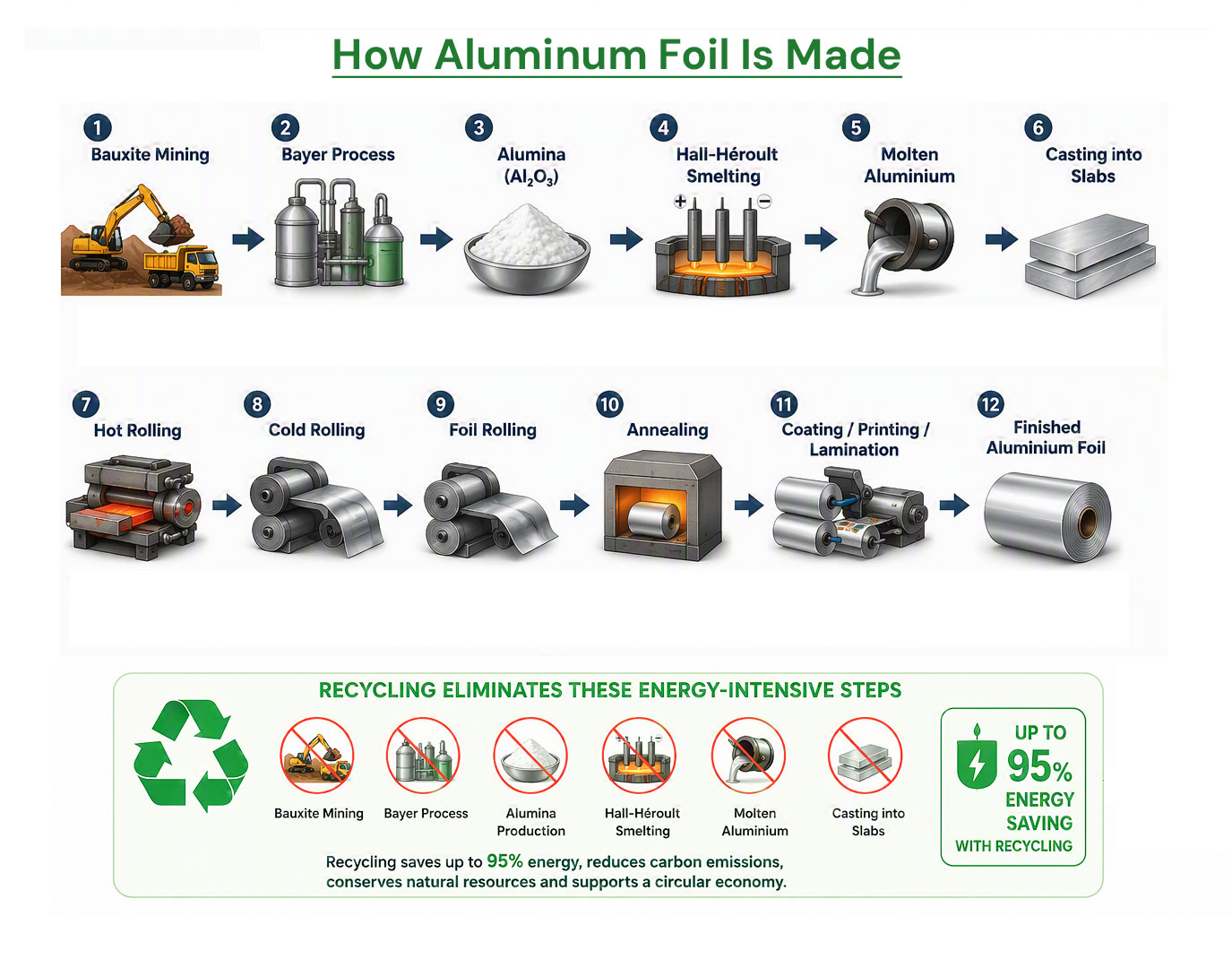
The process begins with bauxite mining, where large quantities of ore are extracted from the earth.
The ore is then refined through the Bayer Process to produce alumina (aluminium oxide).
Next comes the Hall-Héroult smelting process, in which enormous amounts of electricity are used to separate pure aluminum from alumina.
The molten aluminum produced during smelting is cast into slabs and subjected to multiple rolling operations.
Through hot rolling and cold rolling, the metal is gradually reduced in thickness until it becomes extremely thin foil.
Application | Thickness |
Household foil | 10–20 µm |
Pharma blister foil | 20–30 µm |
Flexible packaging foil | 6–12 µm |
Heavy-duty foil | 25–50 µm |
Depending on the application, the foil may go for annealing, printing, coating or lamination before reaching the end user.
This entire production chain requires significant energy, natural resources and infrastructure.
It also contributes to greenhouse gas emissions, land disturbance, biodiversity loss and resource depletion.
This is why recycling of aluminium foil is far more sustainable than continuously producing virgin Aluminum from bauxite ore.
How Aluminum Foil Is Recycled
Not all aluminum foil is recycled by the same method. It depends entirely on condition and level of contamination.
Let’s look at the different recycling routes, so you can make the right choice next time when you discard aluminum foil.
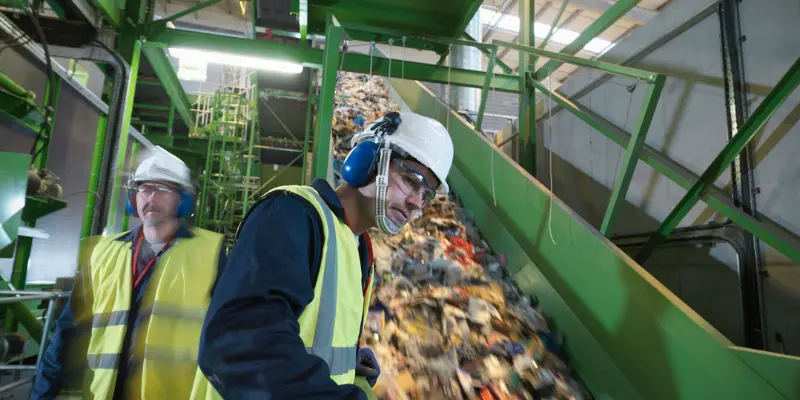
1. Mechanical Recycling (Best for Clean Foil)
This method works well for clean or less contaminated aluminum foil.
Clean Aluminum foil from households, manufacturing facilities or industrial scrap streams is collected and sorted from waste materials.
Because aluminum is non-magnetic, it’s typically separated using an eddy current separator, a device that generates a magnetic field to repel non-ferrous metals like aluminum away from other waste materials.
Once separated, the foil is shredded and then washed to remove impurities. But problems may be created if foil is highly contaminated with grease, oil or food residue.
These organic materials burn during the melting process and can contaminate the molten aluminum, reducing the quality of the recycled aluminum.
This is why cleaning of foil at home before throwing in the bin is important.
After cleaning, the shredded foil is compacted into bales and sent to a smelter/recycler.
At the smelter, it is melted at around 660°C (1,220°F) and refined into molten aluminum.
Impurities float to the surface as slag which are then skimmed off.
The clean molten aluminum is then cast into ingots/slabs for making new packaging materials.
This method gives highest material recovery at lower cost and environmental impacts.
Producing aluminum from recycled material requires approximately 95% less energy than producing it from raw bauxite ore, according to the Aluminum Association.
Standard mechanical recycling works best for foil that is:
- Clean or lightly soiled foil
- Not laminated with plastic or paper material
- Thick enough for machine detection
2. Pyrolysis (Best for Moderately Contaminated Foil/Laminated Foil)
Much of the foil used in commercial food packaging is a laminated with plastic or paper, like snack wrappers, tetra pack, coffee sachets and other ready to eat products.
Standard mechanical recycling cannot easily separate these layers, which means this laminated foil is often rejected from conventional recycling streams.
But Pyrolysis offers a solution for this kind of laminated aluminum foil.
Pyrolysis is a thermal decomposition process in the absence of oxygen that breaks down organic material, such as plastic, adhesive layers and ink.
The laminated material is heated at 300°C and 500°C temperatures (Below melting point of the aluminum foil).
At these higher temperatures, the polymer layers decompose into gases or oils, which can be captured and used as fuel.
The remaining Aluminum can then be recovered.
This process is useful for:
- Laminated food packaging
- Pharmaceutical blister packs
- Highly contaminated foils.
3. Waste to Energy (When Recycling Isn't Possible)
Some Aluminum foil is so heavily contaminated with grease, oil or food waste that can’t be recycled directly.
In such cases, the material may be processed in waste-to-energy facilities.
During incineration, these waste materials generate useful heat and energy.
The remaining bottom ash still contains Aluminum fragments, which can later be recovered using metal separation technologies such as eddy current separators.
The recovered Aluminum is then re-melted and returned to manufacturing applications.
Although this route is less preferable than direct recycling, it is still better than sending foil directly to landfill because both energy and metal value can be recovered.
Why Recycling of Aluminum Foil Is Important
The benefits of Aluminum recycling are substantial.
100% Recyclable: Aluminum can be recycled repeatedly without quality degradation.
Massive Energy Savings: Aluminum foil recycling requires approximately 95% less energy than producing virgin Aluminum from bauxite ore.
Lower Greenhouse Gas Emissions: Less energy use means lower carbon emissions.
Reduced Mining: Recycling decreases dependence on bauxite extraction, helping to protect forests and biodiversity.
Conservation of Resources: Valuable raw materials remain within the circular economy.
Supports Circular Packaging: Aluminum can move from one product to another indefinitely while maintaining performance.
Conclusion
So, is aluminum foil recyclable? Absolutely. In fact, it is one of the most recyclable packaging materials available today.
Aluminum can be recycled indefinitely without losing quality, requires around 95% less energy than primary Aluminum production and helps to reduce mining, greenhouse gas emissions and resource depletion.
Whether through mechanical recycling, pyrolysis or waste to energy systems, most Aluminum foil has a pathway back into the circular economy.
The challenge is not the recyclability of Aluminum foil—it is ensuring that this valuable material is properly collected, sorted and recovered instead of being lost to landfills or the environment.
FAQs
Throwing away aluminum foil breaks the circular economy and completely wastes the energy used to create it. Since aluminum can be recycled infinitely without losing quality, discarding it forces us to mine new raw materials. This unnecessary process burns 95% more energy than simply melting down and reusing the old foil.
No, aluminum foil is not biodegradable and will not rot like organic waste. Instead, it breaks down over hundreds of years through slow corrosion, leaving behind aluminum oxide compounds. This permanent nature makes recycling vital to keep it out of landfills.
Yes, you can recycle aluminum pans in your standard curbside bin if they are completely clean.
No, you cannot recycle aluminum foil with food on it. Food residue and grease contaminate the recycling process and can ruin an entire batch of clean materials. If the foil is heavily soiled with burnt food, cheese, or thick grease, you must throw it directly into the trash bin. However, if the food is easy to remove, you can simply rinse and wipe the foil clean, roll it into a tight ball, and recycle it
Yes, Aluminum foil is generally safe for food packaging, as it acts as an absolute barrier against light, oxygen, moisture and bacteria.
