Moisture is one of the biggest problems for pharmaceutical packaging.
Even a small amount of unwanted moisture can affect the quality, stability and shelf life of medicines.
This is why pharmaceutical manufacturers use desiccants for the sensitive drug products.
A desiccant absorbs excess moisture and helps to maintain a dry environment inside the bottle pack throughout the product’s intended shelf life.
But how do you calculate desiccant for pharmaceutical bottles? Should you use one canister, two or more?
The answer depends on several factors, including bottle headspace, moisture ingress, moisture present in the tablets and the adsorption capacity of the selected desiccant.
In this guide, we will explain how to calculate desiccant quantity for the bottle pack using a simple example.
Choosing the right amount of desiccant is essential for protecting moisture-sensitive medicines.
Using too little desiccant may not be enough to protect the medicine.
On the other hand, using more desiccant than necessary can increase the packaging costs.
A scientific way helps to estimate the moisture level inside the bottle and helps to calculate an appropriate quantity of desiccant.
Before starting the calculation, it is important to understand three major sources of moisture:
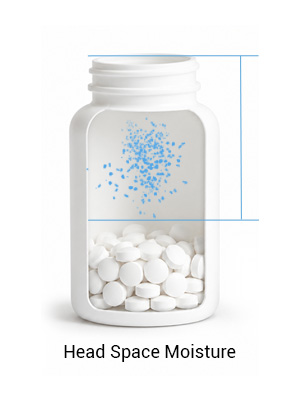
1. Bottle Headspace: Moisture already present in the air (trapped inside the bottle).
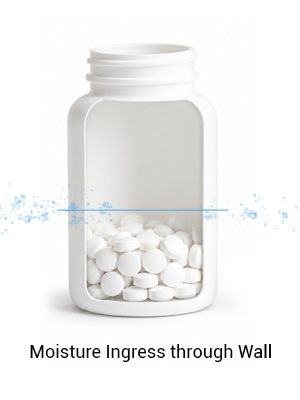
2. Moisture Ingress: Water vapour entering through the bottle wall and closure system over the intended shelf life.
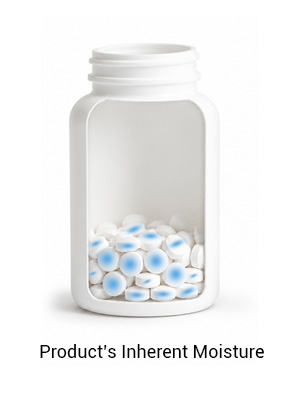
3. Product’s Inherent Moisture: Moisture already present in the tablets or other pharmaceutical products.
Let’s understand how to calculate each of these factors.
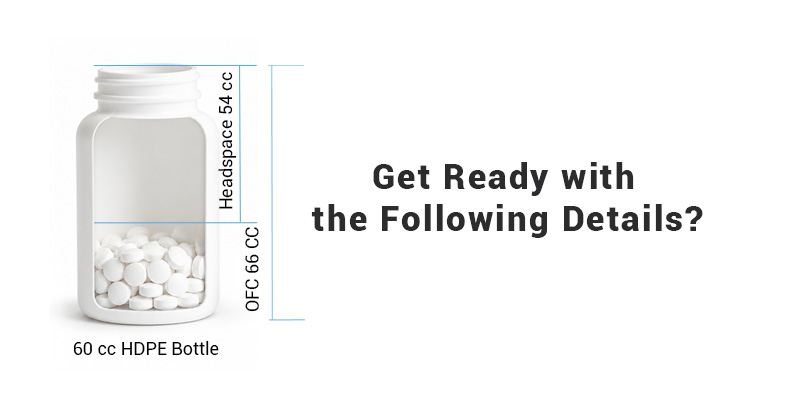
Suppose a pharmaceutical manufacturer wants to pack 30 tablets inside a 60 cc HDPE bottle.
The objective is to determine how many 1 g silica gel canisters are required for each bottle.
These are the details to be collected for the calculation.
Using these values, let’s calculate the desiccant requirement step by step.
After filling tablets and induction sealing, a pharmaceutical bottle contains some moisture in the headspace.
This moisture is known as headspace moisture, which must be absorbed for the product protection.
First, calculate the absolute humidity using the following formula:
Absolute Humidity = Maximum Moisture Capacity of Air × Relative Humidity
At 25°C, the maximum moisture capacity of air is 23 g/m³.
The bottle has a headspace volume of 54 cc.
The next source of moisture is the packaging material itself.
HDPE bottles provide moisture protection, but they are not completely moisture-proof.
Over time, water vapour can pass through the bottle wall and closure system.
This moisture transmission is evaluated using a parameter called Water Vapour Transmission Rate (WVTR).
For our example, the bottle supplier’s Certificate of Analysis (COA) provides a WVTR value of 4.014 mg/day/L.
Now, calculate the values:
The third source of moisture is the pharmaceutical drug product itself.
Tablets may already contain a certain amount of moisture.
This can be estimated using the Loss on Drying (LOD) value.
LOD indicates the percentage of weight lost when a sample is dried.
Now, we can calculate the total moisture that needs to be absorbed by the desiccant.
Let’s bring the results together:
We now have the total moisture. The next step is to determine how many silica gel canisters are required to absorb the moisture (655.59 mg).
For this example, each 1 g silica gel canister has an adsorption capacity of 190 mg of water, as specified in the supplier’s COA.
The formula is:
Number of Canisters Required = Total Moisture Load ÷ Adsorption Capacity per Canister
Since pharmaceutical packaging cannot use a fraction of a canister, the calculated requirement must be rounded up to the next whole number.
Therefore:
Required Quantity = 4 Canisters per Bottle
Based on the above calculation, the recommended quantity for this example is:
4 Nos. of 1 g silica gel canisters per 60 cc HDPE bottle containing 30 tablets.
This recommendation is based on the following packaging conditions:
This example demonstrates how manufacturers or packaging professionals can calculate the required desiccant quantity rather than selecting it solely on the basis of bottle size.
The desiccant quantity calculated above provides an initial estimate. However, the final selection should also consider actual packaging conditions, product characteristics and stability study results.
The selected desiccant quantity should be validated by doing a long-term stability study. This will help us to confirm whether the selected packaging and desiccant combination maintains product quality throughout the intended shelf life.
Accelerated stability studies help to evaluate product behaviour under elevated temperature and humidity conditions. These studies can provide useful information about the effectiveness of the packaging system in 6 month of time.
Different pharmaceutical formulations can interact differently with moisture. Understanding the product’s moisture absorption behaviour is important when selecting a suitable desiccant.
The moisture protection provided by a pharmaceutical bottle depends on several factors, including the quality of the closure, liner and seal integrity.
The tablet’s LOD should be considered, as not all moisture in the tablets is available for the desiccant to absorb.
Additionally, moisture can enter the bottle every time a patient opens and closes it during use.
All these factors should be considered while calculating the actual desiccant requirement for better moisture protection.
The actual adsorption capacity of a desiccant depends on its material, grade, environmental conditions and equilibrium humidity. Always refer the supplier’s technical data and COA when performing calculations.
Calculating desiccant requirements for pharmaceutical bottles is an important part of pharmaceutical packaging development. It requires understanding the different sources of moisture and estimating the total moisture load that needs to be managed by the desiccant.
As demonstrated in our 60 cc HDPE bottle example, the calculation considers three major moisture sources: moisture present in the bottle headspace, moisture entering through the packaging material and moisture associated with the tablets.
By considering these factors and comparing the total moisture load with the adsorption capacity of the selected desiccant, pharmaceutical manufacturers can estimate the appropriate number of desiccant canisters required.
However, the calculated quantity should be treated as an initial estimate rather than a final packaging specification.
Actual desiccant selection should also consider product stability studies, moisture absorption characteristics, container closure performance and applicable regulatory requirements.