
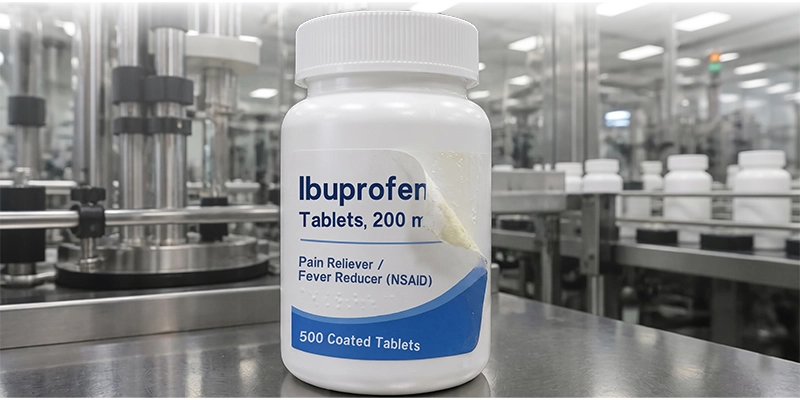
Label Peeling off is a common packaging problem that can affect product appearance, brand reputation, and packaging quality.
Whether you are dealing with labels lifting at the edges, losing adhesion after application, or peeling off during storage and transportation, identifying the root cause is an important thing to do first.
In this article, we explore the science behind label peeling, its common causes, practical troubleshooting methods, and essential tests to help you ensure reliable label adhesion on pharmaceutical and other plastic bottles.
Introduction
It is the last week of the month, and production is running at full speed. Critical batches are packed, quality checks are complete, and everyone is ready to move on.
But the next morning, a problem appears.
Labels on several bottles have started peeling off at the edges. Soon, the issue spreads to dozens of bottles.
Panic sets in, and the packaging team immediately blames the label vendor.
The label vendor points a finger at the bottle supplier.
Production blames the warehouse storage conditions.
Quality starts asking difficult questions, and management wants immediate answers.
Everyone is trying to save their position, but no one is looking at the actual science of labeling.
Ironically, the problem of label peeling off is rarely caused by a single factor.
It is usually the result of a complex interaction between the bottle’s surface, the adhesive’s chemistry, environmental conditions, and the laws of physics.
To solve this, we need to stop the blame gaming and understand the science of labelling.
The Science Behind Label Peeling off: It’s Not Just "Glue"
Many people assume that a label sticks simply because of the adhesive.
But pressure-sensitive adhesives (PSAs) are much more sophisticated.
For a label to bond permanently, it must complete the wet-out process.
The adhesive must flow into the microscopic valleys of the bottle’s surface, forming a molecular bridge. This doesn’t happen instantly; it takes time, generally 24 to 72 hours.
If anything interferes with this wet-out process, the labelling will fail.
Understanding the following causes of label peeling off can help packaging teams identify the root problem and choose the right corrective action.
1. Low Surface Energy
What is it?
Surface energy is defined by how easily a liquid (like an adhesive) can spread across a solid surface.
Think of how water behaves: on a clean glass window, it spreads out, right?
On a waxed car, it beads up into droplets.
Why it causes peeling:
Many plastic bottles, like HDPE and PP, have very low surface energy (around 30 mN/m).
Instead of spreading out, your adhesive wants to bead up, like water on a waxed car.
If the adhesive cannot properly spread on the surface, it cannot form a strong bond, leading to early edge lifting.
Note: Glass and metal have high surface energy and are easy to stick. While PET has moderate, HDPE and PP have low surface energy.
How to Test It: The Dyne Level Test
You don’t have to guess if your bottle has low/high surface energy.
You can test it right on the production floor using a Dyne Test.
This involves using a set of specially formulated marker pens (Dyne pens) or test inks.
You draw a line on the bottle with a specific pen.
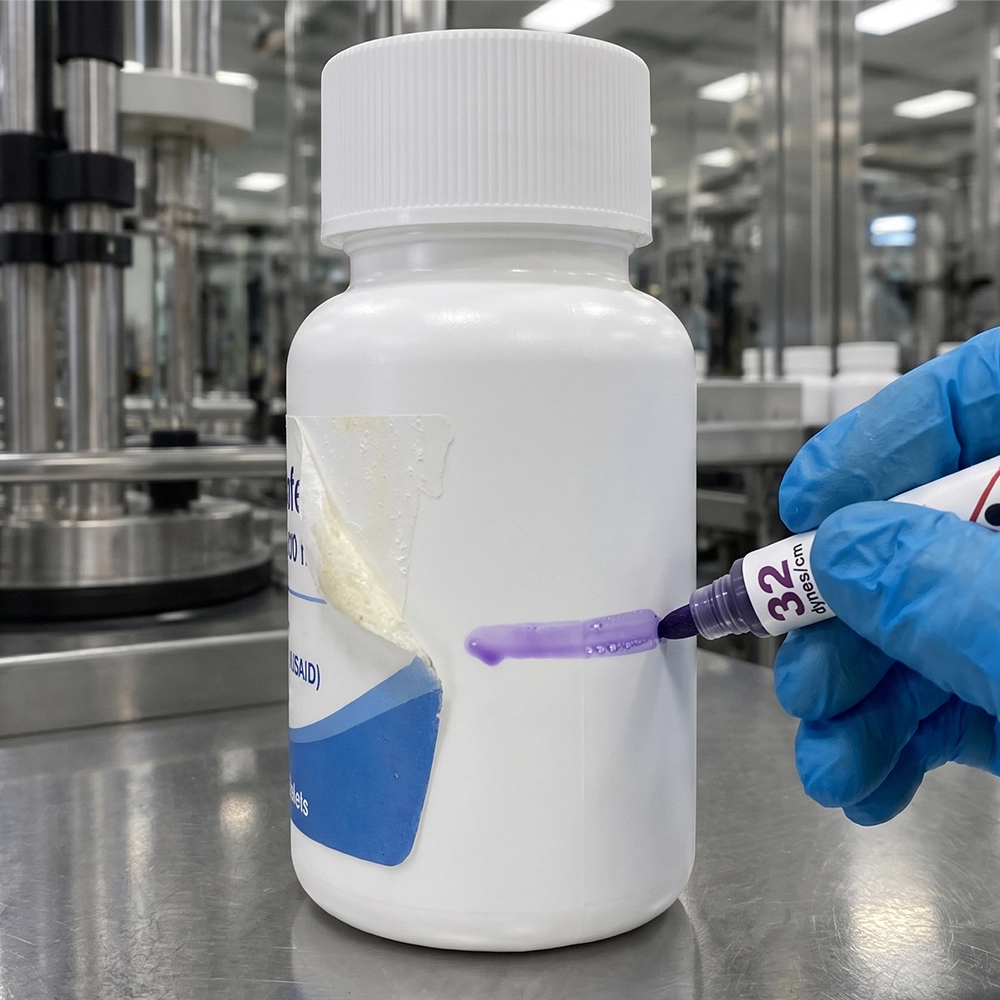
If the liquid stays in a solid line for at least two seconds without beading up, the bottle’s surface energy is high enough to match that pen’s value.
If it beads up instantly into droplets, the surface energy is too low.
By testing different pens (e.g., Pen Value: 30, 34, 38, 42 dyne/cm), you can check the exact surface energy of the bottle.
The golden rule for labeling is that the bottle’s surface energy must be significantly higher than the adhesive’s surface tension for a proper label sticking.
The Solution:
You should not use a conventional adhesive label for a low-surface-energy plastic bottle.
You must select a high-tack adhesive specifically formulated for LSE (Low Surface Energy) substrates.
Additionally, surface treatments like Corona treatment can be done to raise the surface energy of the bottle, making it easier for the adhesive to make a permanent bond.
Always use the Dyne Test to verify the surface energy before selecting label for your bottle.
2. Temperature Delta and Micro-Condensation
What is it?
Temperature fluctuations are a silent killer. Imagine a label is applied at an ambient temperature like 25°C, but the product is immediately moved into a refrigerated area at 2–8°C. This can be the reason for the label peeling off.
Why it causes peeling:
A sudden temperature drop of more than 10°C affects the adhesive’s rheology.
The lower temperature makes the adhesive stiffer, plus it slow down the wet-out process before the bond has established.
Even worse, moving a cold bottle into an ambient temperature causes micro-condensation.
This invisible moisture acts as a barrier, preventing the adhesive from touching the plastic.
The Solution:
Allow products to acclimatize to the room temperature before labeling.
Ensure bottles are completely dry.
If your product goes through a cold chain, you must use adhesives that are suitable for cold temperatures and moisture displacement.
3. Insufficient Dwell Time
What is it?
Dwell time is the period for a label to achieve its maximum bond strength.
Why it causes peeling:
Many acrylic adhesives require 24 to 72 hours for a permanent bond.
If you put your batches immediately after packaging into a cold chain supply (2-8 °C), the adhesive will not spread properly on the surface of the bottle, leading to weak bond between the label and bottle.
The internal memory of the label or the pressure of the shrink-wrapped pallet can easily break this weak or immature bond.
The Solution:
Validate your dwell time.
Ensure labels have at least 24-72 hours of proper conditioning at room temperature before being subjected to cold chain storage.
4. Chemical Migration
What is it?
Sometimes, the problem is not in the label or the environment; it is the bottle itself.
Many plastic containers contain additives like plasticizers, slip agents, or mold-release agents to help them pop out from the molds.
Why it causes peeling:
Over time, these chemicals can migrate to the surface of the plastic bottle.
When they reach the surface, they create a weak, slippery boundary layer between the bottle and the adhesive.
The label will look fine initially, but after 48 hours, the adhesive loses its grip, and we observe label peeling.
The Solution:
Audit your bottle suppliers.
Conduct an IPA Control Group test: Wipe one set of bottles with 99% isopropyl alcohol (which removes surface contaminants) and then paste the label, while for another set of bottles, you just have to paste the label without using alcohol.
If the untouched bottles show label peeling, then it is confirmed that your bottle have excess chemical contamination.
5. Mandrel Stress
What is it?
Have you ever tried to wrap a stiff piece of paper around a small pen?
It tries to unroll. This is known as Mandrel Stress.
Why it causes peeling:
When you apply a label to a tightly curved surface (like a small pharmaceutical vial or a dropper bottle), It constantly “wants” to return to its original flat shape.
This creates a continuous lifting force at the edges.
The adhesive must fight this force every second of the product’s life.
If the label is too thick or rigid, the adhesive will eventually surrender and the label will peel off.
The Solution:
For small-diameter containers, use thinner, more flexible face stocks.
Rounding the corners of the labels can also significantly reduce the peeling force at the edges.
6. The "Modulus Mismatch" (Rigid Label, Flexible Bottle)
What is it?
Modulus refers to a material’s stiffness.
A common myth is that a stiffer or thicker label is better.
But using a rigid label for a flexible plastic bottle is a bad choice.
Why it causes peeling:
Imagine a rigid 3 mil PET label applied to a soft HDPE bottle.
During air freight, the bottle expands and deforms slightly.
The rigid PET label cannot stretch with it.
Instead, its “mechanical memory” violently pulls the label back to its original shape, tearing the adhesive away from the bottle.
This is also seen when bottles shrink in the fridge.
The Solution:
Stop relying on the rule that the label must be stiffer than the bottle.
The goal is conformability.
Use flexible MDO (Machine Direction Oriented) films or softer PE films that can absorb the container’s deformation without transferring that stress to the adhesive.
7. The High Speed of Machine:
What is it?
In modern packaging lines, speed is everything.
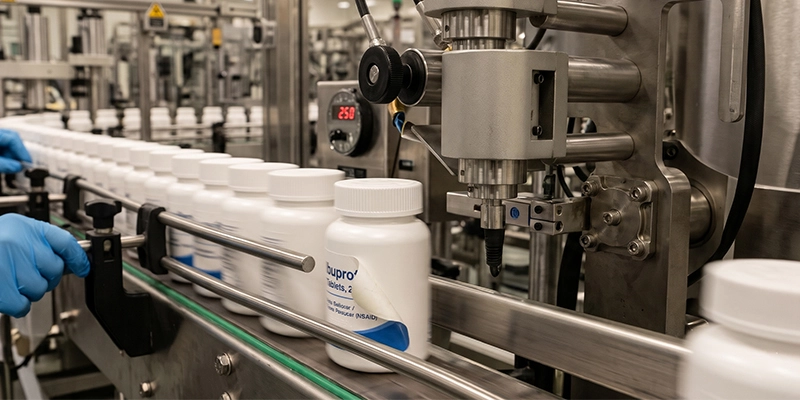
Labeling machines can apply hundreds of bottles per minute.
However, when a machine runs too fast, the delicate balance of adhesive engineering is destroyed as the label leaves its liner.
This is known as adhesive shear failure or adhesive transfer breakdown.
Why it causes peeling:
Think about a strip of Scotch tape.
If you pull it off the roll slowly, the glue stretches and stays perfectly on the tape.
But if you jerk it off violently, the glue snaps and leaves a sticky residue behind.
The exact same thing happens on a high-speed label applicator.
If the machine’s dispensing speed, peel plate geometry, and web tension are not perfectly synchronized, the force required to peel the label off its release liner can exceed the internal strength of the adhesive.
A Real-World Example:
Imagine a pharmaceutical bottle line running at 200 bottles per minute.
The operator pushes the speed to 250 bottles per minute to meet a month-end deadline.
Because of the extreme acceleration, the label is ripped off the liner so fast that the adhesive doesn’t peel properly—it fractures.
Microscopic amounts of adhesive are left behind on the liner (a phenomenon called “adhesive transfer” or “picking“).
The label applied to the HDPE bottle now has a severely weakened, patchy adhesive layer.
It looks fine as it rolls down the conveyor, but because it lacks a uniform molecular bridge, the edges lift and peel off within 48 hours.
The quality team blames the bottle supplier, and the vendor blames the adhesive chemistry.
But the real culprit was the machine’s speed and tension settings breaking the glue layer at the moment of application.
The Solution:
Calibrate Release Force: Work with your label supplier to ensure the adhesive and release liner are matched.
A dynamic release force of 10–15 g/inch is often ideal for high-speed dispensing, but this must be validated on your specific machine.
Slow Down (Slightly): Don’t sacrifice adhesion for speed. Find the optimal machine speed where the adhesive transfers cleanly to the bottle without fracturing.
Check the Peel Plate: Ensure the angle of the peel plate is correct for the stiffness of your label. A sharp, aggressive angle combined with high speed is a recipe for adhesive shear.
Inspect the Liner: After a production run, look at the discarded release liner.
How to Test and Prevent Label Peeling off on Bottles
To ensure your label bonding, you must move beyond standard datasheets and test real-world conditions. Here are the essential tests:
1. The 48-Hour Submersion Test: Keep label pasted bottle into an ice bucket for 48 hours. Check labels for water absorption and ink smearing.
2. The Thermal Shock Test: Apply labels on the bottle and let them dwell. Place them in an oven at 50°C for 12 hours, then shift them immediately into a -20°C freezer for 12 hours. Inspect the edges for any lifting.
3. The Low-Squeeze Fatigue Test: Aggressively squeeze a PE bottle 100 times. If the label delaminates or shows any wrinkles or stress marks, the face stock is to be corrected for the elongation (conformability).
4. The 72-Hour Rule: Check peel strength at 0, 24, 48, and 72 hours. If adhesion deteriorates over time, you have a chemical migration or stress issue, not just an initial tack issue.
5. Match the Modulus: Test rigid vs. conformable labels on the same bottles. If the rigid label fails and the conformable one succeeds, your mechanical mismatch hypothesis is proven.
The Future of Labeling: What’s Next?
The packaging industry is evolving rapidly, driven by sustainability and regulatory changes:
1. PFAS-Free Adhesives:
PFAS (forever chemicals) have historically been used for water and oil resistance.
With new EU regulations (like the PPWR) coming into effect, the industry is shifting toward PFAS-free adhesive labels.
However, you must ensure that replacing your current adhesive for a “green” one doesn’t compromise its ability to stick to your specific bottle.
2. Wash-Off Technology:
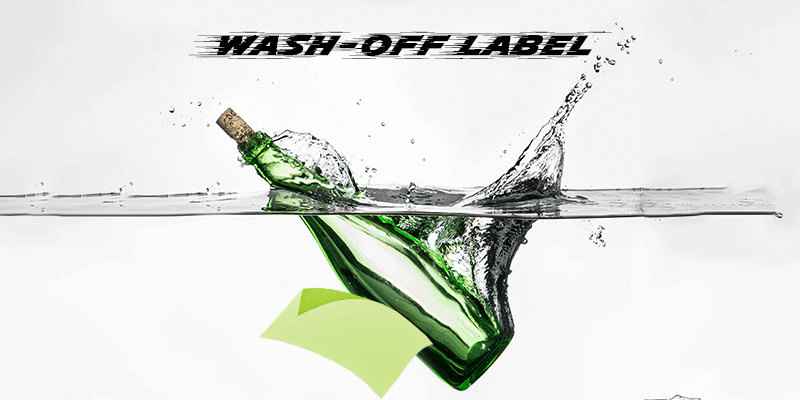
This is a game changer for recycling.
Wash-off adhesives are designed to stay attached during the product’s life but easily separated during the plastic recycling process.
This results in higher-quality recycled resin and a better circular economy.
Read more about: Wash-off label adhesive technology.
Conclusion
When you experience label peeling off within 48 hours of application, the adhesive is not always the problem.
Failure may be because of surface energy, temperature delta, inadequate dwell time, and modulus mismatch.
The good news is that these failures can be preventable.
The most successful companies don’t wait for labels to fall off on the warehouse floor. They test the surface energy, validate dwell times, and challenge their products with thermal shocks and squeeze tests at the development stage.
Because a label is not just a piece of printed paper—it is a highly engineered system where chemistry, physics, and process control must work together perfectly.
When you understand the science, you can stop the morning-after panic and keep your labels exactly where they belong.
