
Artificial Intelligence (AI) in sustainable packaging is transforming the industry by making packaging smarter, more stylish and cost-effective.
It analyses huge data sets and do trial and error tests virtually to suggest the best packaging design and material with lower environmental impact.
It also helps to optimize production operations, improve supply chain efficiency and ensure proper disposal of packaging materials.
In summary, AI helps packaging scientists to develop cost effective sustainable packaging solutions without losing quality and functionality.
So, AI is reshaping the future of sustainable packaging.
Introduction
With the growing crisis of plastic pollution and its deadly impacts on the environment, the demand for sustainable packaging is skyrocketing.
Additionally, governments all over the world are tightening their rules on single-use plastics, Extended Producer Responsibility (EPR) and EU directives to cut down the waste and boost packaging efficiency while keeping sustainability at the core.
Just using sustainable materials in packaging will not resolve the problems, we need to design smart packaging solutions that can balance performance, cost and quality by using minimum materials.
This is where data-driven innovation comes into the field of development.
Role of AI in Packaging
Artificial Intelligence (AI) means teaching machines to think like human and make data driven decisions. In the packaging industry, AI can design, produce and dispose packaging material in a smarter and more sustainable way.
Let’s Understand It.
Design: AI software or tools study the data and suggest plenty of options for structural design with pros and cons.
Manufacturing: AI integrated machine predicts problems before they come and adjusts machine setting parameters automatically to increase production efficiency.
Supply Chain: It predicts demands, make production plan, control inventory and find shortest route to deliver products on time with less fuel and carbon emissions.
Recycling: AI with an optical camera or IR sensor can identify material accurately for efficient recycling.
Top 5 Applications of Artificial Intelligence (AI) in Sustainable Packaging
1. Design Optimization
To understand the role of AI in packaging, let’s take an example of vaccine packaging.
Vaccine products must be stored at 2 °C to 8 °C to maintain their drug potency and supplying these medicines through refrigerated vans means using a lot of fuel and energy.
So, it is very important to design a compact pack for a vaccine that can give maximum pallet occupancy in the cold chain supply.
How can AI help?

AI can try and test thousands of designs for best pallet occupancy within a minute, increasing designing, manufacturing and supply chain efficiency with less carbon emission.
So, by using AI, companies can save cost, time, efforts, material and reduce carbon footprints while keeping vaccines safe and effective.
2. Material Selection and Innovation
Let’s take an example of cough syrup bottle packaging.
Earlier, cough syrup was packed in amber glass bottles, which are prone to break during transit and patient usage.
Later, pharmaceutical companies switched to brown plastic bottles (PET), which has solved the problems of breakages and heavy weight.
But now, we realized that plastic bottles are creating plastic pollution or waste management challenges.
How AI can help
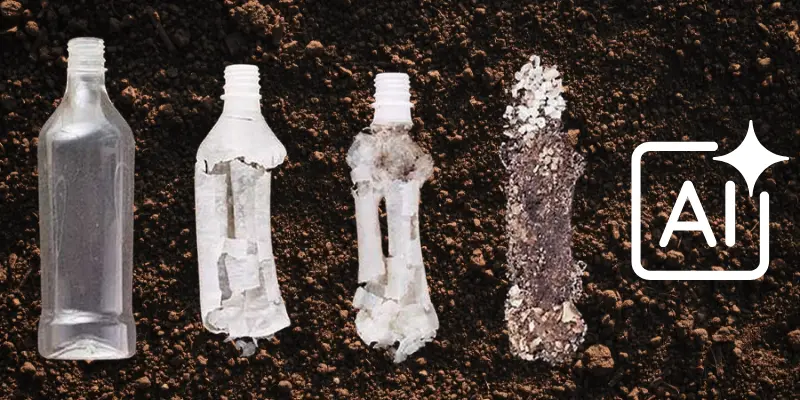
After studying thousands of data for product and packaging, AI models can suggest biodegradable or compostable plastics that can reduce environmental impact.
Plus, advanced AI models can predict the LCA of packaging materials even before using them.
Unlike taking years to switch from glass to plastic bottles, we should use AI to select and innovate packaging materials faster by ensuring that they will be safe, functional and sustainable.
3. Production Efficiency
Production efficiency can be increased just by integrating AI technology with existing machinery.
In sticker labelling machines, many labelling defects often happen, like misalignments, wrinkles, missing labels and machine operators got to know these defects after wasting plenty of materials and packs.
How AI can help
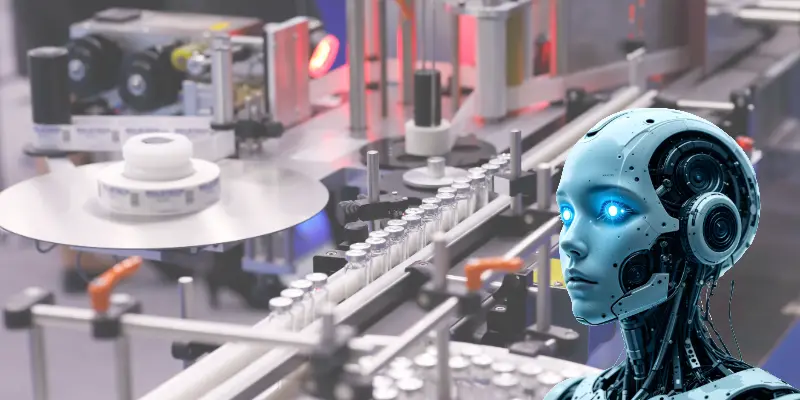
AI integrated sticker label machine can monitor the labelling process accurately in real time and alert the operator immediately upon a single defect or rejection. Additionally, it can find the root cause for the defect and suggest the best corrective action.
AI can also check a machine’s performance and predict when a part or machine is likely to break down. For example, it can warn the operator to replace an existing part before it causes severe damage.
So, by reducing waste and preventing machine breakdowns, AI ensures continuous operations, saves energy and increases overall production output.
Note:
Still, in many industries, preventive maintenance is done even after machines are running smoothly, causing low production output.
By integrating AI in machines, companies can detect issues well in advance and eliminate the need for unnecessary preventive maintenance and increase the production efficiency.
4. Demand and Supply Chain Efficiency
In certain cases, managing and holding some seasonal products like winter jackets can be tricky.
Overproduction leads to higher product waste, while underproduction leads to sales loss.
How AI can help
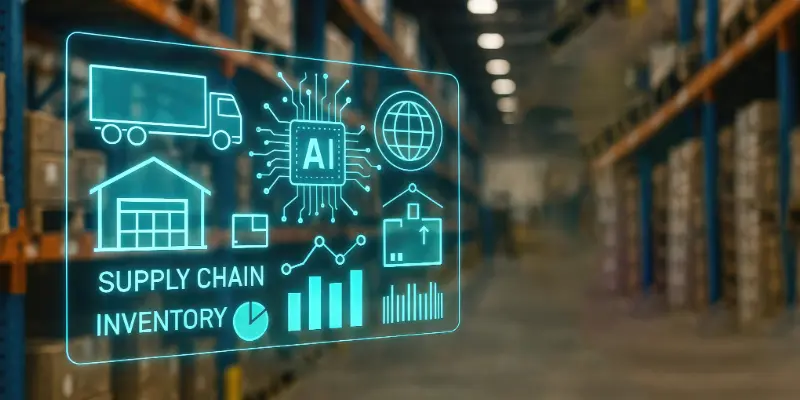
AI can forecast demand by analysing weather conditions, historical sales data and market trends, which will help us to estimate how many jackets will be required for this season.
This can avoid overproduction and underproduction.
Even more, by integrating AI with mapping tools like Google maps and satellite networks, we can find the shortest possible route to deliver products with less time, fuel and carbon emission, increasing supply chain efficiency.
5. Recycling with AI
Note that here I am taking a simple example of a bottle and cap to explain you the role of AI in a waste management system. AI can do even better than this.
Most of the water bottles are made from two different plastic materials, like PET and PP.
Body Part: Polyethylene Terephthalate (PET)
Cap: Polypropylene (PP)
At the recycling facilities during the sorting, workers may mix these materials by mistake and can contaminate the recycling stream, leading to a poor recycling rate.
How AI can help
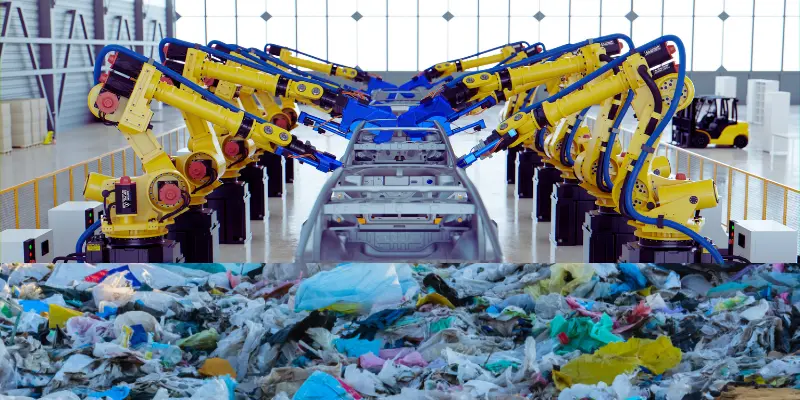
By using AI powered optical camera and infrared sensor, the machine can detect any material quickly and accurately without making mistakes. Upon detection, it can be easily sorted and recycled.
Companies like TOMRA and AMP Robotics use AI-driven vision systems to sort out packaging materials efficiently to make higher recycling rates.
Benefits of AI in Sustainable Packaging
The integration of Artificial Intelligence (AI) in sustainable packaging systems is revolutionizing the way we design, produce, supply and dispose packaging materials.
Beyond automation and efficiency, AI also helps us to make data-driven decisions.
1. Reduced Material Waste & Production Cost
One of the most significant advantages of AI in packaging is to reduce material waste, and production cost.
To finalize the packaging concept till now, we are producing multiple physical prototypes, leading to excessive use of materials, time, cost and efforts.
By using AI, we can test hundreds of virtual designs and finalize packaging concepts without making a single prototype, while on the other hand saving material, development time, cost and our efforts.
2. Development of New Eco-friendly Materials
AI plays a crucial role in developing new sustainable packaging materials quickly.
Through advanced AI integrated data software and machine learning, packaging scientists can try different additive materials or combinations to increase the barrier properties and functionality of the new materials.
AI models can also predict how a new material will perform in terms of barrier properties, strength, flexibility and biodegradability even before filling the product in the packaging material.
This capability speeds up the innovation cycle for biodegradable, compostable and recyclable packaging materials.
3. Enhanced Transparency and Traceability
The integration of AI with other technologies like Blockchain and IoT will provide full traceability of materials from design to disposal.
So, even the end user can track all the authentic details, including material source, energy usage, carbon emission and waste generation in a minute.
Consumers can easily verify the percentage of recycled content, monitor supply chain emissions and generate sustainability reports online.
In summary, AI can build the packaging industry to do more with less — less material, less waste and less environmental harm.
Challenges and Limitations of AI in Sustainable Packaging
While Artificial Intelligence (AI) offers immense potential to revolutionize sustainable packaging, its implementation is not without obstacles.
Many organizations, especially small and medium-sized enterprises (SMEs), face barriers related to cost, expertise and infrastructure.
1. High Implementation Cost
One of the main problems in adopting an AI system in packaging is its significant cost for hardware, software and a skilled workforce.
Accuracy of AI results are fully dependent on high-quality data and advanced analytical tools, which can be costly or difficult to integrate with existing packaging machinery.
Additionally, developing an AI model, maintaining digital infrastructure and providing training to employees are quite difficult and costly.
2. Quality of Data
AI’s output is heavily dependent on the quality and quantity of the data bank. Collecting such datasets in real-world industrial environments can be difficult and challenging.
In many packaging operations, data related to material properties, energy consumption, logistics or waste generation is often not accurate or available.
Poor data quality can misguide you.
3. The Need for Skilled Workforce
To use AI’s full potential, industry professionals should know all about the data interpretation and machine learning tools.
Many packaging engineers, designers and supply chain managers aren’t fully trained in data analytics and AI applications.
The adoption of AI in packaging is slow due to this lack of digital literacy.
4. Data Security or Data Loss
AI software and tools use sensitive information of companies related to production, suppliers, sales and customer behaviours.
Without proper cybersecurity and data management, these data can be leaked or loss.
5. Resistance to Change and a Lack of Standardization
Adopting AI in packaging also faces organizational resistance.
Many companies still rely on traditional packaging processes and hesitate to shift toward digital or data-driven systems.
Moreover, there is no universal standard or framework for using AI in sustainable packaging development.
Future Outlook for AI in Packaging
As industries are continuing to digitize and sustainability becomes a core value for business, AI will play more an important role in designing, manufacturing, distribution and waste disposal from now onwards.
1. The Role of Generative AI in Packaging Design & Creativity
Generative AI is one of the most exciting developments in the field of packaging design and creativity.
Unlike traditional design methods that are completely dependent on the manual inputs and lots of thought processes, Generative AI can create multiple design options within a minute based on proper prompts or commands.
This technology allows engineers and designers to explore innovative shapes, materials and branding concepts that are sustainable and functional.
For instance, a designer could type prompts like “minimum material use,” “100% recyclability,” or “reduced carbon footprint,” and the AI system would instantly generate optimized packaging designs that meet all the criteria.
Generative AI also finalizes a structural design by ensuring how a design will perform in a distribution cycle without the need for actual physical samples and a transit study.
As this technology develops more & more, we can set new standards for design excellence and carbon footprint while keeping sustainability at the core.
2. Rise of Zero-Waste Packaging
By the end of 2030, we may witness the rise of fully automated and zero-waste packaging systems driven by AI, robots and IoT technologies.
Read my post on Zero Waste Packaging.
In this digital world, AI systems will manage every stage of the production process from raw material sourcing to final product disposal without human intervention.
These AI-powered smart systems will drastically reduce carbon emissions and set the new benchmark for sustainable packaging.
Conclusion
Artificial Intelligence (AI) is helping companies to design smarter packaging, choose better materials, optimize production processes, save cost and improve recycling rates.
So, by turning data into decisions with the help of AI, we can reduce waste and carbon emissions and move closer to a circular economy.
To unlock its full potential, sustainability experts and IT professional must work together.
